AI automation platform with enterprise governance and predictable pricing
Activepieces is a workflow automation and AI agent platform for teams that need IT oversight and scalable integrations.
AI Panel Score
6 AI reviews
Reviewed
Users interact with Activepieces through a visual flow builder where triggers, actions, and AI steps are connected without writing code. Pre-built agents — such as a Lead Qualifier, Smart Email Agent, or Daily Report Agent — can be pulled from an agent library and deployed immediately. Teams can also build custom flows using multi-step logic, conditional branching, and embedded code blocks when needed.
The platform includes an AI Adoption Stack designed to measure and increase automation usage across an organization. Admins can monitor active flows, hours saved, cost savings, and per-team adoption rates through a built-in analytics dashboard. A leaderboard and badge system tracks individual contributor activity. Governance features cover SAML 2.0 SSO, SCIM user provisioning, granular RBAC, and audit logs. Connections to over 729 apps include Gmail, Slack, Notion, HubSpot, OpenAI, Salesforce, and Google Analytics.
Activepieces targets both individual builders and enterprise IT teams that need centralized control over automation sprawl. It is positioned as a lower-cost alternative to Zapier and Make, and also competes with n8n in the self-hosted segment. Pricing follows a subscription model with a free starting tier; paid plans are available, with enterprise pricing available via sales. Execution costs are flat rather than per-task on applicable plans.
Deployment options include a fully managed cloud (SOC 2 Type II and GDPR compliant, with EU and US data regions) and a self-hosted option via Docker, Helm, or any cloud provider. Self-hosted installations allow data to remain on-premises and support custom compliance requirements. Development and staging environments are available at no cost on self-hosted deployments.

Lets users build intelligent AI agents with enterprise integrations, custom logic, human approval steps, and agent-specific data sources.
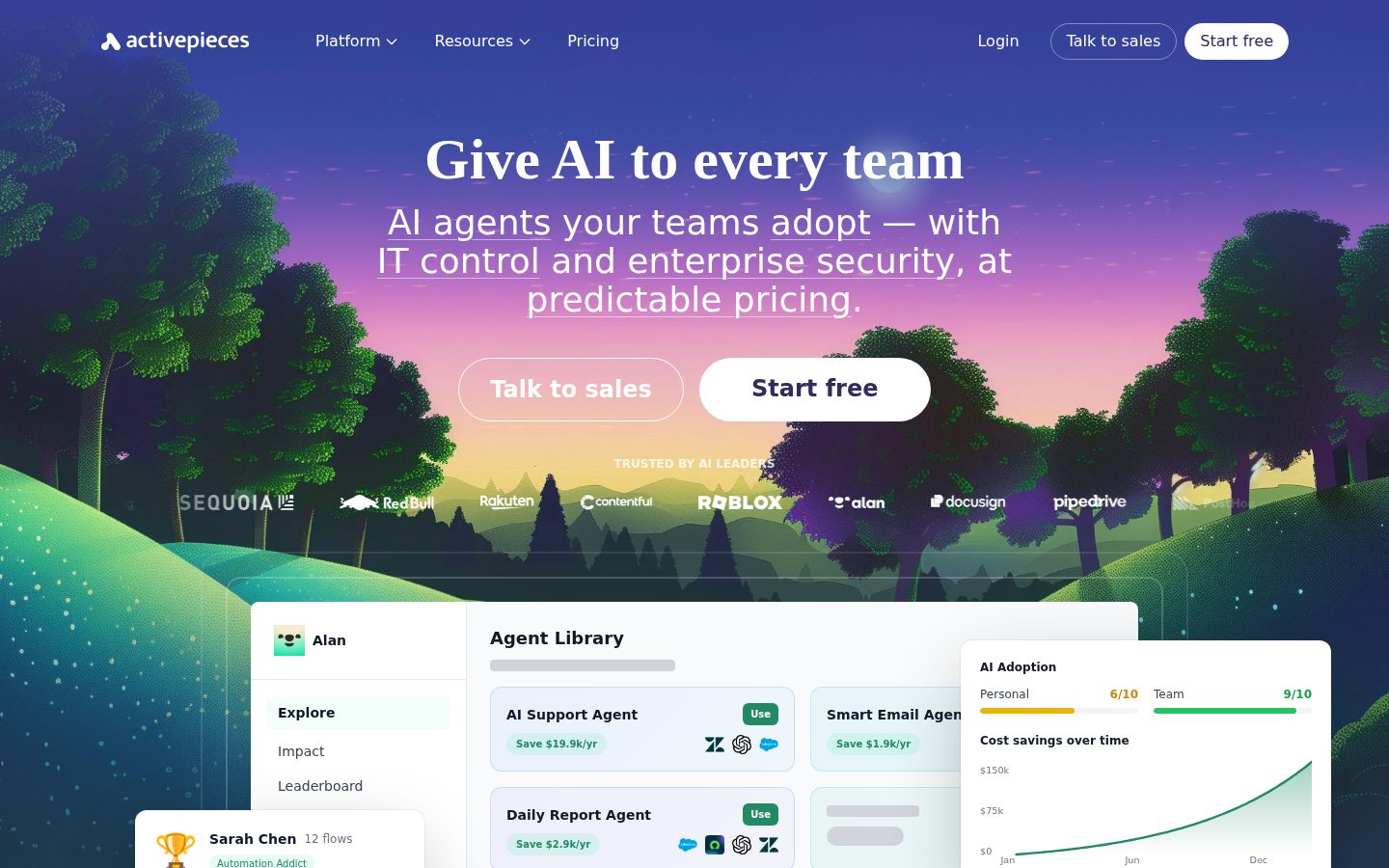
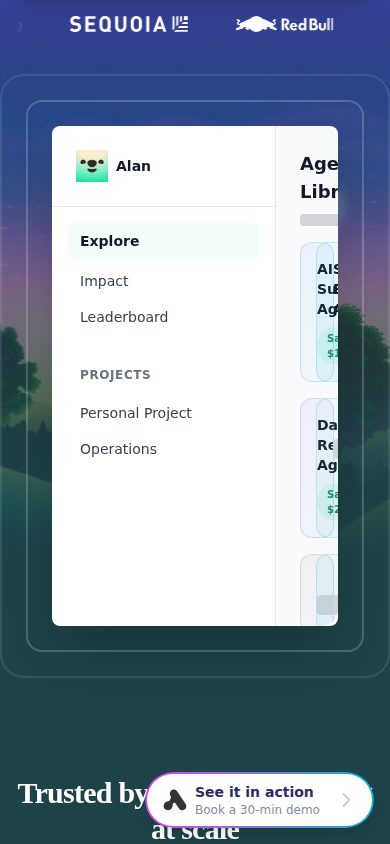
A curated library of pre-built AI agents (e.g., Lead Qualifier, Meeting Summarizer, Inbox Zero Bot) that teams can deploy directly with estimated cost savings displayed.
Tracks org-wide AI adoption metrics including active flows, hours saved, AI agent tasks completed, adoption rate by team, and monthly cost savings over time.
A visual builder that lets users create and manage multi-step automated flows without writing code, supporting complex logic and integrations.
A gamification layer that ranks individuals and teams by time saved and active flows, awarding badges to drive competitive AI adoption across the organization.
Allows organizations to run Activepieces on their own servers via Helm, Docker, or any cloud, keeping data in-network and supporting any compliance requirement with free dev and staging environments.
Allows organizations to apply their own look and feel to the platform, as shown by the branded theme selector in the product UI.
Connects workflows to over 729 third-party apps including Gmail, OpenAI, Slack, Notion, and HubSpot via pre-built integration pieces.
Provides granular role definitions (e.g., Admin, Builder, User) that control exactly who can create, edit, run, or manage flows and billing across the org.
Records platform activity for IT oversight, giving enterprise teams visibility into who did what within the system.
Secures platform access via SAML 2.0 and Google SSO, enabling organizations to connect their existing identity provider.
Automatically syncs users and groups from an identity provider to Activepieces, streamlining onboarding and offboarding at scale.
Activepieces' pricing page content does not list specific plan names or prices — only CTAs to 'Talk to sales' and 'Start free'. No public pricing tiers are visible in the scraped content.
729 integrations, real enterprise controls, and pricing opacity that'll slow procurement.
“Activepieces is a credible Zapier and n8n alternative with genuine enterprise governance built in. The gamification and adoption analytics are differentiated — most workflow tools don't think at the org level.”
729 integrations, SAML SSO, SCIM provisioning, RBAC, and self-hosted deployment via Helm or Docker. That's a feature set that beats early-stage tools and matches what IT actually asks for. The Agent Library — with pre-built agents like Lead Qualifier and Inbox Zero Bot — means business teams can deploy without waiting on engineers.
The AI Adoption Analytics layer is the real differentiator. Tracking adoption rate by team, hours saved, and cost savings over time, with a leaderboard on top — that's an IT leader's argument for budget renewal. Zapier doesn't give you that dashboard. Neither does Make.
No public pricing is the friction point. 'Talk to sales' before you know the number slows every procurement cycle. Self-hosted orgs get dev and staging free, which is smart, but I can't tell the board a number until I've sat through a demo.
Undercuts Zapier on task-based pricing with flat execution costs, and matches n8n on self-hosting while adding the governance layer n8n lacks out of the box.
SOC 2 Type II, GDPR, EU and US data regions — the compliance story is solid enough to present to a cautious board.
Pre-built agents with displayed cost savings estimates and a no-code builder mean a team can deploy a real workflow in a day.
The AI Adoption Stack positions this as org-wide infrastructure, not just a point tool — that's a different conversation than cost savings.
No public funding data and no changelog visible — active development is assumed but harder to verify than peers like n8n.
Mid-market IT teams that need centralized governance over automation sprawl without per-task Zapier fees.
You need pricing transparency before engaging sales, or your org runs on Microsoft 365 identity and needs Teams-native workflow triggers.
729 integrations, flat execution pricing, and real enterprise governance — Zapier's serious challenger.
“Activepieces combines a no-code workflow builder with enterprise controls that IT teams actually need: SAML 2.0, SCIM, RBAC, audit logs, and self-hosting via Docker or Helm. The AI Adoption Analytics dashboard and gamification layer are genuinely differentiated — most competitors don't touch org-wide adoption management at all.”
The governance stack here is built by someone who understands how automation sprawl kills enterprise deployments. SCIM provisioning plus granular RBAC plus audit logs isn't a checkbox list — that's the operational foundation that lets a COO say yes without IT saying no later. Self-hosted deployment with free dev and staging environments removes a real budget friction that Zapier and Make both charge into.
The AI Adoption Stack — leaderboards, team-level adoption scores, cost savings dashboards — is the most operationally interesting piece. Most automation platforms assume adoption happens. Activepieces is designed to drive it and measure it. That matters when you're trying to show a board that AI investment is producing throughput gains, not just licenses.
The missing public pricing is a genuine friction point. If I'm running procurement through a CFO, 'talk to sales' on every tier slows the buying cycle. The Agent Library with pre-built agents like Lead Qualifier and Daily Report Agent shortens time-to-value, but flat execution pricing only applies to certain plans — and without published tiers, budget forecasting is opaque until late in the sales process.
Sits directly between Zapier's ease and n8n's self-hosted control — a positioning that's genuinely underserved at the enterprise mid-market.
SAML SSO, SCIM, RBAC, and audit logs match exactly what IT governance requires before approving org-wide automation rollout.
729+ integrations covering Salesforce, HubSpot, OpenAI, Slack, and Notion covers the core enterprise stack without gaps.
Self-hosting option via Helm or Docker limits lock-in, but custom flows built on 729 proprietary connectors create switching friction over time.
AI Adoption Analytics plus gamification suggests a product roadmap built around organizational behavior change, not just feature count.
Enterprise or mid-market ops teams that need IT-governed automation at scale with measurable adoption metrics.
Your team needs instant self-serve pricing and fast contract cycles without a sales process.
729 integrations, zero public prices — solid product, opaque cost story
“Activepieces competes directly with Zapier and n8n on features and self-hosting flexibility. Pricing is fully gated behind sales, which makes TCO modeling impossible without a call.”
729 integrations. SAML SSO included — not an add-on. Self-hosted via Docker or Helm at no extra license cost. Flat execution pricing on applicable plans avoids the per-task billing that makes Zapier invoices unpredictable at scale. The AI Adoption Analytics dashboard — tracking hours saved, cost savings, and team adoption rates — gives procurement an actual ROI narrative, not a spreadsheet guess.
The problem: no public pricing. Zero. Starting price unknown, tier names absent from the pricing page. For a 50-seat team, I can't run $X × 50 × 12 without a sales call. That adds 2-4 weeks to procurement cycles. n8n publishes $20/seat cloud pricing. Zapier publishes task-based tiers. Activepieces publishes a CTA button.
Auto-renewal terms and termination clauses aren't public either — category norm is 30-60 day windows, but I can't confirm. SSO included is a real differentiator; Zapier taxes SSO at enterprise tier. Self-hosted deployments cut vendor lock-in risk materially. But until pricing surfaces, TCO modeling is a placeholder, not a number.
Sales-gated pricing adds procurement friction; no self-serve checkout visible, which extends vendor onboarding timelines.
Auto-renewal windows, term lengths, and termination clauses are not publicly documented — standard enterprise risk.
No public tiers, no per-seat rates, no plan names — pricing page shows only 'Talk to sales' CTAs per scraped evidence.
AI Adoption Analytics tracks hours saved, cost savings, and team adoption rates out of the box — unusually concrete for this category.
Flat execution pricing and SSO-included architecture reduce hidden costs, but 3-year TCO can't be modeled without disclosed rates.
Mid-market or enterprise teams that need SSO, SCIM, and self-hosting without paying Zapier's enterprise premium.
Your procurement team requires published pricing before approving vendor evaluation.
729 integrations, real enterprise controls, but pricing opacity will slow procurement.
“Activepieces covers the ops automation stack — visual builder, SAML SSO, SCIM, audit logs, self-hosting — at a positioning that undercuts Zapier. The missing public pricing is a genuine blocker for any team that needs budget approval before a POC.”
The governance layer is what stands out. SAML 2.0, SCIM provisioning, granular RBAC, and audit logs in a tool that also has a no-code drag-and-drop builder — that combination usually costs enterprise-tier money elsewhere. Self-hosting via Helm or Docker with free dev and staging environments means IT can actually sandbox this before committing. That's ops-friendly.
Day-three reality: the AI Adoption Analytics dashboard and leaderboard system are genuinely interesting for org-wide rollouts, but gamification badges can feel like overhead if your team just wants flows running reliably. The Agent Library — Lead Qualifier, Inbox Zero Bot, Meeting Summarizer — shortens time-to-value. 729+ integrations covers most ops stacks without custom connectors.
The tradeoff is procurement friction. No public pricing tiers means every serious evaluation hits a sales call before a budget number exists. n8n publishes its self-hosted pricing openly. Activepieces doesn't. For ops teams that run quarterly budget cycles, that slows everything down.
Pre-built agents and visual builder reduce ramp time, but no public pricing creates uncertainty that lingers past the trial.
Docs exist and API is confirmed, but no changelog is a flag — ops teams need to know what broke or changed between deploys.
Self-hosting with Helm/Docker and free staging environments removes deployment friction; missing changelog makes it harder to track what changed week-to-week.
Conditional branching, embedded code blocks, custom AI agents with human approval steps, and SCIM provisioning signal real depth past the no-code surface.
729+ integrations including Slack, HubSpot, Salesforce, and OpenAI covers most ops workflows without gap-filling custom connectors.
Ops teams that need enterprise governance controls and org-wide automation rollout without per-task billing surprises.
Your procurement process requires public pricing before a vendor conversation — this will stall.
Zapier-killer pricing with actual enterprise bones underneath
“Activepieces packs 729+ integrations, real governance controls, and a no-code builder into a flat-rate model that makes Zapier's per-task billing look punishing. The AI Adoption Analytics and gamification layer are genuinely unusual features you won't find elsewhere at this price point.”
The Agent Library is the thing that'll hook people on day one. Pre-built agents — Lead Qualifier, Inbox Zero Bot, Meeting Summarizer — with cost savings estimates displayed right on the card. That's smart product thinking. Most tools make you imagine the value. This one just shows you. Visual builder, 729 integrations, no code required. The first ten minutes probably feel pretty good.
Three months in, the governance stuff starts mattering. SAML SSO, SCIM provisioning, granular RBAC, audit logs — that's a real enterprise stack. The AI Adoption Analytics dashboard with per-team adoption scores and a leaderboard is an unusual bet. Could feel motivating or could feel like being watched. Depends entirely on your company culture.
Big caveat: pricing is fully opaque. The pricing page just says 'Talk to sales' and 'Start free.' No numbers anywhere. That's a friction wall for anyone trying to budget-compare against n8n or Make. Web-only platform means mobile is a non-starter. For a tool pitched as org-wide automation, that's a quiet limitation.
The Agent Library with cost savings estimates and the branded theme selector suggest real attention to daily UX, though no changelog is publicly visible to confirm ongoing refinement.
No-code drag-and-drop builder handles the first hour well; code blocks and multi-step conditional logic give builders room to grow without hitting a ceiling.
Web-only platform — no mobile app listed anywhere — for a tool pitched as automation for every team is a real gap.
Pre-built agents with immediate deploy options and a visual no-code builder lower the first-session barrier considerably compared to category competitors like n8n.
SOC 2 Type II certification and self-hosted Docker/Helm options suggest infrastructure seriousness, but no public changelog or uptime page makes it hard to assess day-to-day stability claims.
Mid-market IT teams that need to govern automation sprawl across departments without paying Zapier's per-task tax.
You're a solo builder who needs quick pricing transparency and wants to automate anything from your phone.
729 integrations, no public pricing — classic enterprise bait-and-switch setup
“Solid feature set. Real governance story. But the opaque pricing and missing changelog are yellow flags I can't ignore.”
Three tells upfront. One: meta description says 'best way to build' — the kind of superlative that ages poorly. Two: no public pricing tiers visible, just 'Talk to sales.' Three: no changelog listed in capabilities. That's three things I'd expect from a transparent vendor, absent.
The actual product story is more interesting than the landing page deserves. SAML 2.0 SSO, SCIM provisioning, granular RBAC, audit logs, self-hosting via Docker or Helm — that's a real enterprise governance stack, not marketing veneer. The AI Adoption Analytics with leaderboards and badge systems is either genius or cringe depending on your org culture. The 729+ integrations number is credible and specific. SOC 2 Type II is verifiable.
Competitor framing works: cheaper than Zapier, self-hostable like n8n, with governance n8n doesn't match. The tradeoff is real though — no public pricing means budget conversations start blind. Could go either way on long-term viability; no funding data visible.
Combining n8n-style self-hosting with SCIM provisioning and gamified adoption analytics is a distinct enough position vs. Zapier and Make.
Self-hosting via Docker/Helm means your data and flows stay on-premises; cloud lock-in risk is lower than most competitors.
No public funding data, no changelog cadence visible — hard to assess shipping velocity or runway from public materials.
No public pricing tiers and 'best way to' headline undermine an otherwise substantive product story.
Self-hosted + enterprise governance angle mirrors n8n's survival pattern more than Zapier imitators that faded; no changelog weakens the signal.
Mid-market IT teams that need self-hosted workflow automation with real governance controls and don't want Zapier's per-task billing.
You need transparent pricing before an internal budget approval process.
Common questions answered by our AI research team
Activepieces supports 729+ app integrations.
Yes, Activepieces includes SAML SSO as an enterprise control, alongside SCIM provisioning and role-based access control.
The Agent Library is a collection of pre-built AI agents teams can deploy, such as an AI Support Agent, Smart Email Agent, and Daily Report Agent, with estimated annual cost savings shown for each.
Yes, Activepieces tracks AI adoption with usage analytics at both personal and team levels, displayed as adoption scores (e.g., Personal 6/10, Team 9/10), plus gamification features like leaderboards.
Yes, workflows are built through a visual drag-and-drop builder that requires no coding.