AI meeting notes personalized to your format, language, and vocabulary
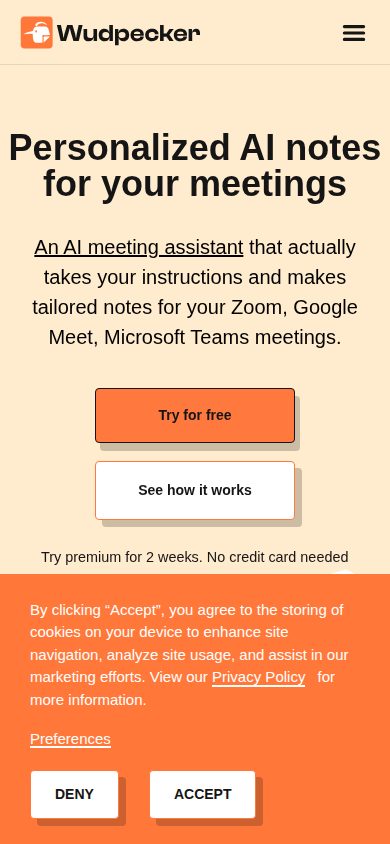
Wudpecker is an AI meeting assistant for teams that automatically records, transcribes, and summarizes Zoom, Google Meet, and Microsoft Teams meetings.
AI Panel Score
6 AI reviews
Reviewed
AI Editor ApprovedApproved and published by our AI Editor-in-Chief after full panel analysis.Wudpecker is an AI meeting assistant that automatically records, transcribes, and summarizes Zoom, Google Meet, and Microsoft Teams meetings. Its key differentiator is customization: users define instructions covering note format, language, and level of detail, set preferred structures, specify vocabulary spelling, and choose from 35 output languages, while a built-in chat interface called Ask Wudpecker answers follow-up questions about meeting content. Other capabilities include speaker identification, color-coded chapters, CRM and productivity integrations, and GDPR-compliant EU data hosting. Pricing starts at $19 per month for the Plus plan, with a free plan and a free trial; the Pro tier is $32. TopReviewed's six-seat AI review panel scored it 7.6/10, praising custom note instructions that match team standards rather than generic AI defaults, while noting the 30-meeting monthly cap on the Plus plan is tight for active sales teams. It best fits sales and customer success teams pushing consistently formatted notes into HubSpot or Salesforce.
In practice, users connect Wudpecker to their Zoom, Google Meet, or Microsoft Teams account. The tool joins meetings, records audio, and produces a written summary after the session ends. Users can configure instructions in advance so each summary follows a consistent structure — for example, separating action items from discussion points, or formatting certain data as tables.
Distinctive capabilities highlighted on the product site include: note output in any of 35 languages, custom vocabulary entries so product names or proper nouns are transcribed correctly, a text-to-table conversion for structured data, and an AI chat feature (Ask Wudpecker) that lets users query their meeting content to develop ideas or extract specific information after the fact. Notes and insights can be pushed into external tools through integrations.
Wudpecker targets sales and partnerships teams, customer success managers, marketers, and talent acquisition professionals. The platform offers a free tier and a two-week premium trial without requiring a credit card. Named competitors on the site include Gong, Jiminny, Chorus, Dooly, Avoma, Fathom, Grain, Fireflies, Supernormal, and tl;dv.
Wudpecker is a web-based platform. Data is stored on EU servers and the product is GDPR compliant. Data at rest is encrypted with AES-256 and transit is secured via mandatory HTTPS.

Uses ChatGPT-powered AI to generate structured meeting summaries that highlight key points, decisions, and action items with deadlines immediately after each meeting.
An AI assistant that lets users query one or multiple past meetings to extract specific insights, answer questions, or draft follow-up emails without manually searching transcripts.
Recordings are automatically divided into color-coded chapters based on topics discussed, enabling users to jump to specific sections of a meeting quickly.
Users can organize calls into named collections (folders) with custom templates, making it easy to group and manage meetings by project, team, or use case.
Meeting notes can be shared directly to another user's Wudpecker account or via a view-only link with any stakeholder outside the platform.
Wudpecker automatically sends a notetaker bot to join Zoom, Google Meet, and Microsoft Teams meetings to record and transcribe the full conversation.
Supports transcription in over 35 languages including English, Spanish, French, German, Japanese, Arabic, and more, with the ability to output notes in any language regardless of the meeting's spoken language.
Automatically identifies and labels different speakers in the transcript, with the ability to manually edit speaker names for accuracy.
Users can instruct Wudpecker to format notes in a preferred structure, add tables, capture specific details, and even build a vocabulary of special names and keywords the AI will remember.
Integrates with tools including HubSpot, Salesforce, Notion, Slack, and Google Docs to push meeting summaries and insights directly into existing workflows.
Dedicated iOS and Android apps allow users to record in-person or on-the-go meetings and receive AI-generated notes without needing a virtual meeting setup.
As an EU-based company, Wudpecker stores all recordings on EU servers with AES-256 encryption at rest, mandatory HTTPS in transit, and a dedicated data governance team ensuring GDPR compliance.
Individuals who want to try AI meeting notes at no cost, with basic usage limits.
Professionals and growing teams who want more meetings and advanced AI capabilities. $15/mo billed annually (approx. 20% savings).
Power users and teams with high meeting volume needing up to 100 bot-recorded meetings per month. $25/mo billed annually (approx. 20% savings).
Solid meeting notes tool at $19 — EU-hosted, customizable, and ready to pilot.
“Wudpecker does what it says: records, transcribes, and formats notes the way your team actually wants them. The 35-language output and custom vocabulary set it apart from Fireflies and tl;dv for international teams.”
Helsinki-based, GDPR-native, freemium entry point. No public funding data, which is the honest gap here — but the changelog shows active shipping and the pricing page shows a real product with three tiers. At $19/month for Plus, the board won't flinch. Two things give me pause: the 30-meeting monthly cap on Plus is tight for high-volume sales teams, and there's no API listed, which limits custom workflow depth.
The Ask Wudpecker chat feature and text-to-table conversion are genuinely useful for CS and sales reps who live in follow-ups. HubSpot and Salesforce integrations mean notes land where reps actually work, not in another tab nobody checks.
The tradeoff vs. Gong or Chorus is real: those platforms own revenue intelligence, Wudpecker owns note quality. If you need call analytics and coaching, look elsewhere. If you need clean, structured notes your team will actually read — pilot this.
Stronger customization than Fireflies or tl;dv, but Gong and Chorus own the enterprise revenue intelligence layer Wudpecker doesn't touch.
EU-hosted, AES-256 encrypted, GDPR-compliant — the board's security question is answered before it's asked.
No credit card required for the two-week trial; teams see structured notes after their first meeting.
Custom note templates and CRM pushes to HubSpot and Salesforce advance sales and CS workflows, not just cost-cutting.
No public funding data; Finnish startup with active changelog and live pricing, but 3-year survival is an open question.
Sales and CS teams that need clean, consistently formatted notes pushed into HubSpot or Salesforce without a six-figure contract.
You need call coaching, revenue analytics, or more than 100 bot-recorded meetings a month.
Solid operational fit for mid-market teams that live inside Zoom, Meet, and Teams.
“Wudpecker delivers a well-scoped meeting intelligence workflow at $19-32/seat with genuine customization depth that Fireflies and tl;dv don't match on template control. The hard ceiling is the per-meeting cap model, which creates friction as team meeting volume scales.”
The customizable note templates and 35-language output aren't cosmetic features — they're process standardization at the point of capture. For a COO trying to enforce consistent post-meeting hygiene across sales, CS, and recruiting, that's operational leverage. AES-256 at rest plus EU hosting answers the GDPR question cleanly, which matters if any of your customer base is European.
The meeting cap structure is the constraint I'd watch. At Pro, you're capped at 100 bot-recorded meetings per month per seat. A mid-sized sales team in a high-velocity quarter will hit that ceiling. If we adopt this at 20 seats, in 18 months we're negotiating overages or pushing users onto workarounds — neither is acceptable ops hygiene.
HubSpot and Salesforce integrations are present, which covers the CRM handoff. No public API, though, so custom workflow automation is blocked without a workaround. Against Gong, Wudpecker won't win on conversation intelligence depth — but at $25/seat annually versus Gong's pricing, it's a different strategic bet entirely.
Priced below Gong and Avoma with stronger customization than Fathom or tl;dv, making it a credible mid-market option, though it hasn't yet differentiated on analytics depth.
Collections, shareable view-only links, and CRM pushes to HubSpot and Salesforce map directly to how sales and CS teams actually route meeting outputs downstream.
HubSpot, Salesforce, Notion, Slack, and Google Docs cover most mid-market stacks, though the absence of a documented API limits deeper process integration.
No public API means workflow automation depends entirely on their native integrations; if your ops stack evolves, you're dependent on Wudpecker's integration roadmap, not your own.
Custom vocabulary, template instructions, and text-to-table conversion show genuine workflow thinking, but no conversation analytics or deal intelligence puts a ceiling on strategic value versus Gong or Chorus.
Mid-market teams needing standardized, multilingual meeting documentation with direct CRM handoff at a predictable per-seat cost.
Your team runs more than 100 recorded meetings per seat monthly or requires deep conversation analytics for revenue forecasting.
$19/seat with clean tiers and a free plan — rare honesty in this category
“Wudpecker publishes three tiers without a sales call. The math works at team scale, but meeting caps create real budget exposure at growth.”
Three tiers, all priced publicly. Free at 10 meetings/month, Plus at $19 monthly ($15 annually), Pro at $32 monthly ($25 annually). 50-seat team on Plus annual: $15 × 50 × 12 = $9K/year. Add 30% seat creep by year 3 — lands near $14K. Still competitive against Fireflies or Fathom at similar tiers.
The meeting cap is the real variable. Pro allows 100 bot-recorded meetings/month per user. Heavy-meeting teams — sales, CS, recruiting — will hit that ceiling. No published overage rate on the pricing page. That's the number you need before signing. Month-over-month billing available, so at least exit isn't locked.
SSO status unconfirmed from public evidence. For enterprise procurement, that's a blocker. EU hosting and AES-256 encryption help with GDPR-sensitive buyers. HubSpot and Salesforce integrations reduce manual workflow cost. No API listed — custom integration work falls on your team.
Freemium entry and no-credit-card trial reduce procurement friction; no API limits self-serve integration options for larger orgs.
Monthly billing available, annual saves ~20%, no evidence of punishing auto-renewal windows or termination clauses from public materials.
All three tiers published with monthly and annual rates, no sales call required, trial available without a credit card.
Time-saved-per-meeting ROI is intuitive for sales and CS teams, but no published benchmark data to validate the claim.
Sticker is low, but no published overage rate for meeting caps creates unpredictable year-3 cost for high-volume teams.
SMB sales or CS teams under 50 seats that need structured, multilingual notes without enterprise procurement overhead.
Your team runs 100+ bot-recorded meetings monthly per user and needs a confirmed overage policy before signing.
Fathom's customization gap, filled — but 100-meeting cap will sting heavy users
“Wudpecker earns its place through genuine customization depth: structured templates, custom vocabulary, and 35-language output are all real daily-use differentiators. The meeting caps on every paid tier are the friction point that compounds over time.”
The custom vocabulary feature is the thing I'd actually miss switching away. Competitor names, internal codenames, product handles — those are the words that break every other transcript. Wudpecker lets you pre-load them so the AI learns your org's language before the call starts. That's day-three value, not demo value. Ask Wudpecker querying past meetings without manually scrolling transcripts is also genuinely useful for knowledge workers who live in back-to-back calls.
The cap structure is the real tradeoff. Pro at $32/month gives you 100 bot-recorded meetings. For a CS manager or recruiter running 5 calls a day, that's gone in three weeks. Fathom and Fireflies both offer unlimited recording at competitive price points. If your meeting volume is high, the math turns against Wudpecker fast.
Workflow integration looks solid — HubSpot, Salesforce, Notion, Slack, Google Docs are all there per the feature list. The docs indicate EU data hosting with AES-256, which matters for European teams. No public API listed, though, which limits power-user extensibility.
Custom templates and vocabulary persist across meetings, so the setup investment pays off daily — but the 100-meeting Pro cap is a recurring psychological speed bump for high-volume workers.
The changelog exists, which is a good sign, but no public API docs and no evident developer-facing content suggests docs are written for buyers, not builders.
Color-coded chapters and speaker identification reduce post-meeting friction meaningfully, but no public API means any custom automation hits a wall.
Collections, custom instructions, text-to-table conversion, and cross-meeting AI querying give real power-user surface area; the ceiling is the missing API layer.
HubSpot, Salesforce, Notion, Slack, and Google Docs integrations cover the core knowledge worker stack; notes push outward without requiring manual copy-paste.
Knowledge workers in sales, CS, or talent roles who need consistent, structured notes across multilingual calls and operate under 100 meetings per month.
You're running more than 25 recorded calls a week and need unlimited capture without doing monthly cap math.
Wudpecker gets the customization thing right where Fireflies mostly doesn't
“Solid meeting assistant with a genuine differentiator in custom note formatting and 35-language output. The 30-meeting cap at $19/month is the ceiling you'll hit faster than you expect.”
The custom instructions angle is real. Most tools in this category — Fireflies, Fathom, tl;dv — give you a summary and call it a day. Wudpecker lets you tell it how to structure notes before the meeting even starts. Custom vocabulary so your product names don't come out garbled. Tables for structured data. That's not a gimmick. That's something you'd actually use by week two.
Ask Wudpecker is the sleeper feature. Query across past meetings, draft follow-up emails, pull specific information without scrolling a transcript. The Plus plan at $19/month caps you at 30 bot-recorded meetings though — that's a real constraint if you're in back-to-back calls. Pro at $32 gets you 100. The math matters depending on your calendar.
Mobile apps exist for iOS and Android, which puts Wudpecker ahead of tools that treat mobile as a footnote. EU hosting and AES-256 encryption will matter to anyone in a regulated industry. Finnish company, GDPR native. That's not nothing.
Color-coded chapter segmentation and editable speaker names suggest attention to daily friction, though no public evidence of how empty states or error handling behave.
Collections, custom templates, and Ask Wudpecker give you somewhere to grow, but the depth of the customization system means month-three users will unlock things day-one users never find.
Dedicated iOS and Android apps support in-person recording with AI notes — that's a real mobile product, not a read-only companion.
No credit card required for the two-week trial, free tier includes the core bot plus 10 meetings — that's a low-friction first hour by any measure.
Email notifications when notes are ready implies async delivery rather than instant post-meeting results, which is fine but worth knowing going in.
Sales reps, customer success managers, or recruiters who live in structured meetings and need consistent, formatted notes without reformatting by hand every time.
You're a solo user with light meeting volume who just needs a basic transcript — the free tier's 10-meeting cap will frustrate you fast.
Solid Fathom competitor, but 30 meetings/month at $19 is a real ceiling
“Wudpecker does the basics well and the customization angle is genuine, not just marketing. The meeting caps and no public API are structural concerns I'd watch before committing.”
Three tells up front. One: no public funding data visible — Finnish startup, Helsinki-based, no round listed. Two: the Pro tier caps at 100 bot meetings/month, which isn't 'power user' territory for high-volume sales teams. Three: no API in the capabilities check. That last one matters if you want real workflow depth.
The customization story holds up. Custom vocabulary, 35+ output languages, text-to-table, and per-user note templates are specific, named features — not vague 'AI-powered' language. Ask Wudpecker querying across multiple meetings is a real differentiator vs. Fireflies and tl;dv at similar price points. CRM integrations with HubSpot and Salesforce add credibility for the sales team use case.
Exit portability is moderate. Notes are shareable via link, but no API means programmatic export is unclear. Changelog exists. Marketing is grounded. Not a slam dunk, but not a red flag factory either.
Custom vocabulary and cross-meeting AI chat are concrete differentiators vs. Fireflies and Fathom, but Gong and Chorus have deeper sales intelligence that $32/month can't match.
Notes export via shareable links and integrations with Notion and Google Docs, but no public API means bulk migration would be manual.
Changelog and pricing page exist, EU data hosting is a real compliance advantage, but no public funding and no API suggest early-stage resource constraints.
Tagline is specific and functional — 'personalized to your format, language, and vocabulary' maps directly to real named features like custom vocabulary and 35-language output.
Pattern matches mid-tier AI notetakers that carved niches before consolidation — same trajectory as Grain; survival depends on whether customization holds as a moat.
EU-based SMB teams needing multilingual notes with custom formatting at a reasonable price point.
You run high-volume sales cycles that need deep conversation intelligence or workflow automation beyond what HubSpot push covers.
Common questions answered by our AI research team
Wudpecker supports 35 output languages for generated meeting notes.
Yes, users can define their preferred note structure, format, and level of detail through custom instructions that Wudpecker applies when generating notes.
Yes, Ask Wudpecker is a built-in chat interface that lets users ask follow-up questions about meeting content.
Yes, users can specify vocabulary spelling so that particular words are transcribed exactly as preferred.
Wudpecker's privacy and security policies are available at wudpecker.io under the Privacy & Security section.
Company
WudpeckerFounded
2022Pricing
From $19/moFree Trial
AvailableFree Plan
AvailableWudpecker is an AI meeting-notes startup based in Helsinki that records, transcribes, and summarizes video calls for Zoom, Google Meet, and Microsoft Teams.