Baseten logo

Baseten Review

Visit

GPU inference infrastructure for deploying AI models in production

Baseten is a model inference platform for teams deploying open-source AI models at production scale.

AI Panel Score

8.0/10

6 AI reviews

Reviewed

AI Editor Approved

About Baseten

Users deploy models on Baseten by selecting from a prebuilt model library or bringing their own, then routing traffic through OpenAI-compatible API endpoints. The platform manages GPU allocation, autoscaling, and cold-start optimization automatically. Teams can compose multi-step workflows using Chains, which supports per-step autoscaling and observability across multi-model pipelines.

Baseten's platform includes several distinct capabilities: dedicated single-tenant inference clusters with SRE support, multi-cloud GPU capacity pooling to handle bursty demand, managed multi-node training with checkpointing and a path from training directly to production, and structured outputs and tool-calling support on Model APIs. The platform also offers embedded forward-deployed engineering support for performance and reliability optimization. Observability features include CI/CD integration, deployment versioning, rollback, logs, metrics, and workspace access controls.

Baseten targets AI engineering teams at companies running inference-heavy workloads—customers include Patreon, Writer, Zed Industries, and Wispr Flow. Pricing is usage-based with pay-as-you-go options and enterprise dedicated deployment plans; specific pricing details are available on the pricing page. Named competitors in the managed inference category include Together AI and Fireworks AI.

Deployment options include Baseten Cloud (SOC 2 and HIPAA compliant), self-hosted within a customer's own VPC or on-premises, and a hybrid mode blending both. The model library includes models such as DeepSeek-V3, DeepSeek-R1, Llama 4, Qwen3, Whisper, and various TTS models. The platform supports vLLM and SGLang runtimes and provides FP8 quantization for throughput optimization.

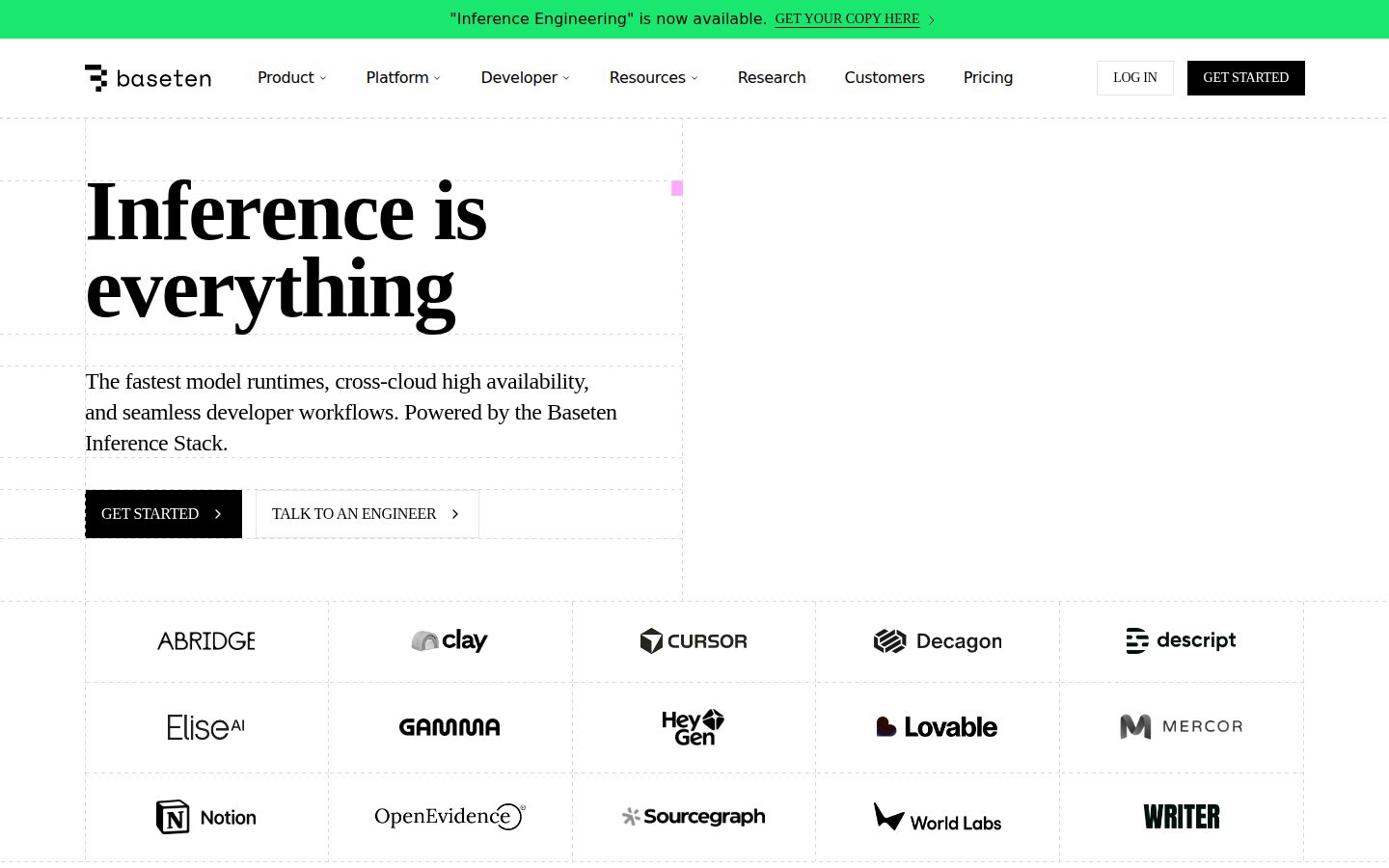
Features

AI

  • Chains

    Production framework for composing multi-step, multi-model workflows with per-step autoscaling and observability.

  • Compound AI

    Design agentic and multi-model systems that coordinate tools and models with production-grade routing and scaling.

  • Training

    Managed infrastructure to run multi-node training jobs with checkpointing and a direct path from training to production.

Automation

  • Autoscaling

    Automatically scales model deployments up or down to handle varying inference loads.

Core

  • Baseten Hybrid

    Blends on-premises and cloud capacity to align latency, compliance, and cost for sensitive or bursty workloads.

  • Dedicated Deployments

    Single-tenant, region-locked inference clusters with enterprise security and SRE support for maximum reliability and performance.

  • Model APIs

    OpenAI-compatible APIs for top open-source models with optimized throughput, structured outputs, tool-calling, and built-in observability.

  • Model Management

    Deploy, version, roll back, and observe models with CI/CD, logs, metrics, and access controls.

  • Multi-cloud Capacity Management

    Aggregates GPU supply across clouds into a single elastic pool to meet bursty demand with low latency and predictable costs.

Security

  • Baseten Self-hosted

    Runs Baseten within your own VPC or on-premises to keep data in-house while retaining performance and management tooling.

  • Workspace Access Control

    Manages access to workspaces for enhanced security across the Baseten platform.

Support

  • Embedded Engineering

    Forward-deployed experts who help optimize performance, reliability, and cost for mission-critical inference.

Preview

Baseten desktop previewBaseten mobile preview

Pricing Plans

Pay As You Go

Contact sales

Usage-based inference pricing for model APIs, dedicated deployments, and training infrastructure. No fixed tiers; costs scale with GPU consumption.

  • Model APIs with OpenAI-compatible endpoints
  • Dedicated single-tenant inference clusters
  • Multi-node training jobs with checkpointing
  • Autoscaling across multi-cloud GPU pool
  • Pay per GPU/compute consumed

Enterprise

Contact sales

Enterprise-grade deployment with dedicated SRE support, compliance, and embedded engineering for mission-critical inference at scale.

  • Single-tenant dedicated deployments with region-locking
  • SOC 2 / HIPAA-ready infrastructure
  • Self-hosted, cloud, or hybrid deployment options
  • Embedded forward-deployed engineering support
  • Enterprise security, access controls, and SLAs
  • Multi-cloud capacity management with elastic GPU pooling

AI Panel Reviews

The Decision Maker

The Decision Maker

Strategic bet, vendor viability, timing, adoption approval
8.1/10

Baseten is the serious choice for inference-heavy teams who need production GPUs fast.

Solid managed inference platform with real customers like Patreon and Writer. Positioned squarely between DIY cloud and competitors like Together AI and Fireworks AI.

Named customers matter more than logos. Patreon and Zed Industries aren't running toy workloads — they're inference-heavy, latency-sensitive businesses. Chains for multi-step pipelines and vLLM plus SGLang runtime support signals a platform built by people who've actually debugged production inference, not just packaged it.

The deployment flexibility is the real differentiator. Self-hosted VPC, hybrid, or fully managed with SOC 2 and HIPAA — that's the answer to three different compliance conversations. Together AI and Fireworks AI don't hand you embedded forward-deployed engineers. Baseten does, at enterprise tier.

Two concerns. No public funding data, so viability requires a direct conversation. And pay-as-you-go GPU spend without visible rate cards means your finance team will ask questions you can't answer today. Pilot before committing.

Competitive Positioning7.8

Embedded engineering support and multi-cloud GPU pooling differentiate from Together AI and Fireworks AI on more than just price.

Reputation Risk8.0

Patreon, Writer, and Wispr Flow as named customers makes this an easy board conversation — peers are already using it.

Speed to Value8.3

Pre-optimized Model APIs for DeepSeek-R1, Llama 4, and Whisper mean you can run production traffic in hours, not sprints.

Strategic Fit8.5

Chains and Compound AI features advance agentic workloads — this isn't just cost savings, it's new capability for inference-heavy teams.

Vendor Viability7.2

No public funding data available, but named enterprise customers and SOC 2 / HIPAA compliance suggest real organizational maturity.

Pros

  • Embedded forward-deployed engineering at enterprise tier — unusual in this category
  • Chains framework handles multi-step, multi-model pipelines with per-step autoscaling
  • Flexible deployment: VPC, hybrid, or fully managed with SOC 2 and HIPAA
  • Model library includes DeepSeek-R1, Llama 4, Qwen3 — current, not stale

Cons

  • No public funding data — viability requires a direct conversation before signing
  • No free trial makes evaluation harder than with Together AI or Fireworks AI
  • GPU-consumption pricing without visible rate cards creates budget uncertainty

Right for

AI engineering teams running inference-heavy production workloads who need compliance-ready, multi-cloud GPU infrastructure without building it themselves.

Avoid if

You're prototyping on a small budget and need a free tier to validate before spending.

The Domain Strategist

The Domain Strategist

Craft and strategy in the product's domain — adapts identity per category, same lens
8.4/10

Baseten is the inference platform for teams who've outgrown managed APIs and need real control.

Baseten sits in a narrow but critical gap: teams running open-source models at scale who need more than Together AI or Fireworks AI offer but won't rebuild GPU infrastructure from scratch. The Chains feature and VPC self-hosting together signal a platform built by people who've actually debugged multi-model pipelines in production.

The architecture here is coherent in a way most inference platforms aren't. Per-step autoscaling inside Chains is the right primitive for compound AI systems — most competitors autoscale at the deployment level and leave you managing inter-model latency yourself. vLLM and SGLang runtime support plus FP8 quantization tells me the team knows where throughput actually lives. Someone on the engineering side has spent real time profiling inference, not just wrapping APIs.

The deployment surface is genuinely strong for regulated or data-sensitive orgs. SOC 2 and HIPAA compliance with a self-hosted VPC option plus hybrid burst capacity is a serious enterprise posture — that's not a checkbox, that's an architectural commitment. The tradeoff is opacity on pricing: pay-as-you-go GPU consumption with no published rate card means you're negotiating blind until you're already building.

If we adopt this, in 3 years we have a team with deep inference operations muscle but real switching cost baked into Chains workflow definitions and embedded SRE relationships. That's a bet worth taking if inference is your core workload. If your roadmap is mostly fine-tuning and training, the managed training path looks thin compared to the inference depth.

Category Positioning8.3

Occupies the defensible middle ground between commodity shared inference (Together AI, Fireworks AI) and full DIY GPU clusters, with enterprise compliance as a real differentiator.

Domain Fit8.6

CI/CD integration, deployment versioning, rollback, and workspace access controls map directly to how ML engineering teams actually run production model lifecycles.

Integration Surface8.2

OpenAI-compatible endpoints mean zero re-tooling for existing inference code; hybrid VPC mode fits teams with mixed cloud and on-prem data gravity.

Long-term Implications7.8

Strong path from training to production, but Chains workflow lock-in and undisclosed pricing create compounding switching cost and budget unpredictability at scale.

Strategic Depth8.5

Per-step autoscaling in Chains plus vLLM/SGLang runtime selection and FP8 quantization shows library-grade inference depth, not surface-level API wrapping.

Pros

  • Chains with per-step autoscaling is the right primitive for multi-model production systems
  • VPC self-hosted plus hybrid burst is a mature enterprise deployment posture
  • vLLM and SGLang runtime support signals serious inference engineering, not wrapper-layer thinking
  • Embedded forward-deployed engineering is a genuine differentiator for teams without deep MLOps bench depth

Cons

  • No published GPU pricing rates means cost modeling requires a sales conversation before you can plan
  • No free trial makes evaluation gated for teams doing legitimate POC work
  • Training infrastructure appears secondary to inference depth — not the right bet if training is your primary workload

Right for

AI engineering teams running inference-heavy open-source model workloads who need enterprise compliance and multi-model pipeline orchestration.

Avoid if

Your workload is primarily model training or fine-tuning and inference at scale isn't your dominant operational concern.

The Finance Lead

The Finance Lead

Money, total cost of ownership, contracts, procurement math
7.2/10

Usage-based GPU inference with no published per-GPU rate — TCO is a forecast, not a number.

Baseten targets inference-heavy AI teams with solid architecture: autoscaling, multi-cloud GPU pooling, VPC deployment, SOC 2 / HIPAA. The sticker price is 'pay as you go' but no public GPU rate means no real budget model without a sales call.

Both listed plans show 'Free' as price — that's a pricing page artifact, not reality. Usage-based with zero published $/GPU-hour is the real story. Together AI and Fireworks AI publish token rates. Baseten doesn't. That gap is the core procurement risk. Year-3 TCO at 50-engineer AI team running continuous inference workloads could be $200K or $800K. You can't model it without a quote.

The feature set is legitimate. Chains, per-step autoscaling, multi-node training with checkpointing, VPC self-hosted, hybrid mode — that's an enterprise-grade stack. Embedded forward-deployed engineering is a real differentiator, though it likely sits behind an enterprise contract with a term and auto-renewal window that aren't published.

The tradeoff: architectural depth is real, pricing opacity is real. Teams with predictable inference volume will struggle to benchmark against Fireworks AI without a custom quote. If you need HIPAA compliance or VPC isolation, the feature set justifies the conversation. If you want a monthly bill you can forecast, look elsewhere first.

Billing & Procurement6.0

Pay-as-you-go model reduces upfront commitment but no invoice predictability; no free trial means procurement must engage sales before any spend validation.

Contract Flexibility5.8

No published auto-renewal terms, cancellation clauses, or term lengths — enterprise SLA language is entirely opaque from public materials.

Pricing Transparency4.5

No $/GPU-hour published; both plans list 'Free' as price, which is misleading — actual rates require a sales conversation.

ROI Clarity7.0

Observability features — logs, metrics, CI/CD integration, deployment versioning — give engineering teams real data to measure inference cost and latency improvement.

Total Cost of Ownership5.5

Usage-based with no public rate card makes 3-year TCO modeling impossible without a custom quote; embedded engineering support likely adds undisclosed cost at enterprise tier.

Pros

  • VPC self-hosted and hybrid deployment options satisfy strict data residency requirements
  • SOC 2 and HIPAA compliance documented — healthcare and regulated verticals can proceed
  • Chains feature enables multi-model pipeline billing visibility at the step level
  • Multi-cloud GPU pooling addresses burst capacity without long-term reservation risk

Cons

  • No published GPU-hour or token rate — impossible to model TCO without sales engagement
  • No free trial: zero spend validation before committing
  • Enterprise contract terms, auto-renewal windows, and SLA details are fully opaque
  • Against Fireworks AI and Together AI, who publish rates, Baseten loses the self-serve procurement comparison

Right for

AI engineering teams at companies like Patreon or Writer running HIPAA-scoped or VPC-isolated inference workloads who can negotiate a custom rate card.

Avoid if

Your finance team needs a forecastable monthly GPU bill before signing anything.

The Domain Practitioner

The Domain Practitioner

Daily hands-on reality in the product's domain — adapts identity per category, same lens
8.2/10

Serious inference infrastructure for teams who've outgrown Together AI and Fireworks AI

Baseten is purpose-built for AI engineering teams running heavy open-source model inference in production. OpenAI-compatible endpoints, vLLM/SGLang runtime support, and multi-cloud GPU pooling cover the core deployment surface without forcing you to babysit infrastructure.

The model library ships with DeepSeek-R1, Llama 4, Qwen3, Whisper — the models ML teams are actually deploying right now, not last year's benchmarks. FP8 quantization and SGLang runtime support tell me someone on the infra team has actually debugged throughput bottlenecks. OpenAI-compatible endpoints mean your existing inference client code ports with near-zero changes. That's day-one friction nearly eliminated.

Chains is the feature I'd stress-test hardest. Per-step autoscaling on multi-model pipelines sounds right, but the docs indicate Compound AI and agentic routing are on the same platform — that's a lot of surface area where observability gaps show up under real traffic. The changelog exists, which is a good sign, but no free trial means you're committing before you've seen cold-start behavior on your actual workload shapes.

The real tradeoff: Pay As You Go gives you GPU-consumption billing with no floor, but Enterprise dedicated deployments with SRE support and embedded engineering are where the reliability guarantees live. For a team running inference-heavy production workloads, the VPC self-hosted option plus hybrid flex capacity is genuinely differentiated versus Fireworks AI's model. The compliance story — SOC 2 and HIPAA on Baseten Cloud — closes deals that Together AI can't.

Day-3 Reality8.0

OpenAI-compatible APIs and prebuilt model library minimize early friction, but no free trial means cold-start and autoscaling behavior on your specific workload is unknown until you're paying.

Documentation Practitioner-Fit7.5

Docs are confirmed present and the feature set specificity (vLLM, SGLang, FP8, per-step autoscaling) suggests practitioner authorship, though depth can't be fully assessed from public evidence.

Friction Surface7.8

Chains and Compound AI add real surface area where observability gaps could compound; the changelog exists but specific pricing requires contacting sales, which slows cost-modeling during eval.

Power-User Depth8.4

Multi-node training with checkpointing, hybrid VPC deployments, FP8 quantization, and embedded forward-deployed engineering support give power users meaningful advanced surface to work with.

Workflow Integration8.3

CI/CD integration, deployment versioning, rollback, and OpenAI-compatible endpoints plug into existing ML engineering pipelines without demanding new tooling habits.

Pros

  • vLLM and SGLang runtime support with FP8 quantization — someone's actually tuned for throughput
  • OpenAI-compatible endpoints mean minimal client-side refactoring
  • VPC self-hosted plus hybrid flex capacity is genuinely differentiated versus Fireworks AI
  • SOC 2 and HIPAA compliance closes regulated-industry deals without a custom infra build

Cons

  • No free trial means you can't profile cold-start behavior before committing GPU spend
  • Enterprise pricing requires sales contact — cost-modeling during eval is friction
  • Chains and Compound AI multi-model surface area is where observability gaps will appear first under real load
  • Pay As You Go has no published per-GPU floor rate, making budget forecasting opaque

Right for

AI engineering teams running inference-heavy production workloads on open-source models who need VPC deployment, compliance coverage, and multi-cloud GPU elasticity.

Avoid if

You're a solo ML engineer or small team prototyping — no free tier and opaque pricing make low-scale experimentation expensive to start.

The Power User

The Power User

Daily human experience, onboarding, polish, learning curve, reliability
8.1/10

Serious infrastructure for teams who've outgrown Together AI and need more control

Baseten is a production inference platform built for AI engineering teams running real workloads, not demos. The feature set is deep; the entry bar is steep.

This isn't a tool you spin up on a Thursday afternoon to see what happens. Baseten is infrastructure — multi-cloud GPU pooling, VPC deployments, Chains for multi-step model workflows, embedded SRE support. The changelog shows a team shipping hard. Customers like Patreon and Writer aren't running hobby projects. This is production-grade stuff with the pricing to match: pay-as-you-go sounds approachable, but there's no free trial, no free tier, and the enterprise plan requires a conversation. You're not dipping a toe in.

For daily polish — hard to score without live access, but the docs indicator is on, pricing page exists, changelog is active. That's a team that cares about the paper trail. The Mobile Parity score gets hurt because this is web-only infrastructure tooling; checking your inference metrics from your phone isn't the point, but it's still not nothing.

The real tradeoff: Fireworks AI and Together AI will onboard you in minutes. Baseten wants your architecture diagram. If you need that level of control — dedicated single-tenant clusters, HIPAA compliance, hybrid VPC — it's worth the friction. If you don't, it's overkill.

Daily Polish7.5

Active changelog and structured docs suggest ongoing attention to developer experience, but no free trial means polish is hard to verify firsthand.

Learning Curve7.0

OpenAI-compatible APIs flatten the initial integration, but Chains, multi-node training, and hybrid deployment configs add real complexity over time.

Mobile Parity4.5

Web-only platform; checking inference metrics or deployment status on mobile isn't a real use case here, but it's still a gap.

Onboarding Experience6.5

No free trial and no free plan means day one requires a GPU budget commitment — that's homework before you've even seen the product.

Reliability Feel8.5

Dedicated single-tenant clusters, multi-cloud GPU pooling, CI/CD rollback, and named enterprise customers like Writer suggest a platform built to stay up.

Pros

  • Multi-cloud GPU pooling handles bursty demand without manual capacity planning
  • Chains feature enables per-step autoscaling across multi-model pipelines
  • VPC and hybrid deployment options satisfy genuine compliance requirements
  • Embedded forward-deployed engineering support is rare at this tier

Cons

  • No free trial means you're committing real spend before you know if it fits
  • Steep learning curve for teams new to production inference infrastructure
  • Web-only; no meaningful mobile surface for on-call monitoring
  • Pricing details require contacting sales for enterprise plans

Right for

AI engineering teams running inference-heavy production workloads who need GPU autoscaling, compliance options, and more control than Together AI offers.

Avoid if

You're prototyping, early-stage, or just need a quick hosted model endpoint without infrastructure overhead.

The Skeptic

The Skeptic

Contrarian. Watch-outs, deal-breakers, broken promises, category patterns
7.8/10

Solid inference infrastructure play — but no pricing transparency is a yellow flag

Baseten is a credible managed inference platform with real customers and real differentiation. The missing starting price and no free trial aren't dealbreakers, but they slow trust-building.

Named customers matter. Patreon, Writer, Zed Industries — not vaporware logos. The Chains feature for multi-step pipeline autoscaling is specific and genuinely useful, not just a rebranded webhook. SOC 2 plus HIPAA plus VPC self-hosting plus hybrid mode is a meaningful compliance story that Together AI and Fireworks AI both underinvest in. That's a real wedge.

Two yellow flags. One: zero starting prices visible despite a pricing page existing. 'Pay as you go' with no public GPU-hour rate is the kind of opacity that slows procurement. Two: no free trial means evaluation friction is real — enterprise-only discovery isn't a growth strategy.

Exit portability is actually decent. OpenAI-compatible APIs mean vendor lock-in is shallower than average. vLLM and SGLang runtime support suggests models stay portable. If Baseten shuts down, migration is painful but not catastrophic. That matters.

Competitive Differentiation7.8

VPC self-hosting, HIPAA compliance, and Chains multi-model pipelines are real gaps vs. Together AI and Fireworks AI — not just speed benchmarks.

Exit Portability8.2

OpenAI-compatible API endpoints and vLLM/SGLang runtimes mean model code isn't deeply coupled to Baseten-specific abstractions.

Long-term Viability7.5

Embedded SRE support, multi-cloud GPU pooling, and enterprise SLAs signal infrastructure investment, but no public funding data limits confidence.

Marketing Honesty7.5

'Inference is everything' is bold but grounded — the feature list backs it up without overclaiming; no free trial is omitted from the headline pitch.

Track Record Match8.0

Named enterprise customers like Writer and Patreon, plus a changelog, suggest real shipping cadence — matches patterns of platforms that survived past 3 years.

Pros

  • Named production customers across multiple verticals — not just logos
  • Hybrid and VPC self-hosted modes cover compliance requirements Together AI and Fireworks AI don't match
  • Chains feature adds multi-step pipeline orchestration that competitors treat as an afterthought
  • OpenAI-compatible APIs keep exit portability reasonable

Cons

  • No public GPU-hour pricing — 'pay as you go' without numbers is friction in procurement
  • No free trial means evaluation requires a sales conversation
  • No public funding round data visible — harder to assess 3-year runway

Right for

AI engineering teams at growth-stage companies needing HIPAA-compliant, VPC-deployable inference for open-source models at scale.

Avoid if

You need transparent pricing upfront or want a free-tier sandbox before committing to a vendor conversation.

Buyer Questions

Common questions answered by our AI research team

Security

Can I deploy Baseten inside my own VPC?

Yes, Baseten supports self-hosted deployments inside your own VPCs, delivering low latency, high throughput, and the same dev experience as a managed service. A hybrid option adds on-demand flex capacity from Baseten Cloud.

Integration

Does Baseten support ComfyUI workflows?

Yes, Baseten supports ComfyUI workflows for image generation, alongside custom models and fine-tuning for high-quality image output.

Setup

What GPU clouds does Baseten support?

Baseten supports any cloud provider with global capacity, including fully managed Baseten Cloud and self-hosted deployments in your own VPCs across any region.

Features

Is there a pre-optimized API to test models instantly?

Yes, Pre-optimized Model APIs let you test workloads, prototype products, or evaluate the latest AI models optimized for production speed — instantly available.

Also in Machine Learning Platforms